


Webinar: Explainable AI for Disease Prediction in Pets
A large managed-care organization serving patients with chronic conditions such as heart failure and respiratory disease, faced a challenge common across healthcare systems: the most valuable clinical information is often buried within free-text notes and unstructured hospital discharge documents.
Extracting this information manually is slow, resource-intensive, and unrealistic for time-pressured clinicians. To address this, the organization partnered with Spryfox to build a robust, scalable system for reliable data extraction and clinical quality assurance.
The Challenge
The organization aimed to use patient-level insights to improve clinical decision-making, but crucial information such as medication adjustments, background history, and diagnoses was frequently embedded in inconsistent, handwritten, or poorly formatted documentation.
Hospital discharge letters varied widely in structure, contained spelling errors, and often presented multiple medications in long paragraphs or tables with inconsistent formatting.
Although state-of-the-art healthcare NLP tools performed well overall, relying solely on automated extraction was insufficient. The organization required:
- Patient-level quality assurance, not just entity-level accuracy
- A systematic approach for identifying errors, missing fields, and implausible values
- A feedback loop that enabled clinicians to review, correct, and continuously improve system performance
- Reduced clinical workload, even when human review remained part of the process
Spryfox was engaged to design and implement a solution that met these needs.
The Solution
Spryfox developed an end-to-end NLP-driven quality assurance workflow built around advanced healthcare-specific language models. The framework included three core components:
- Automated Entity Extraction
Using OCR and healthcare NLP pipelines, the system extracted:
- Medication names
- Doses and frequencies
- Patient demographics
- Conditions
- Dates and timing information
It supported free-text formats, tables, and documents with spelling inconsistencies.
- Intelligent Quality Labeling
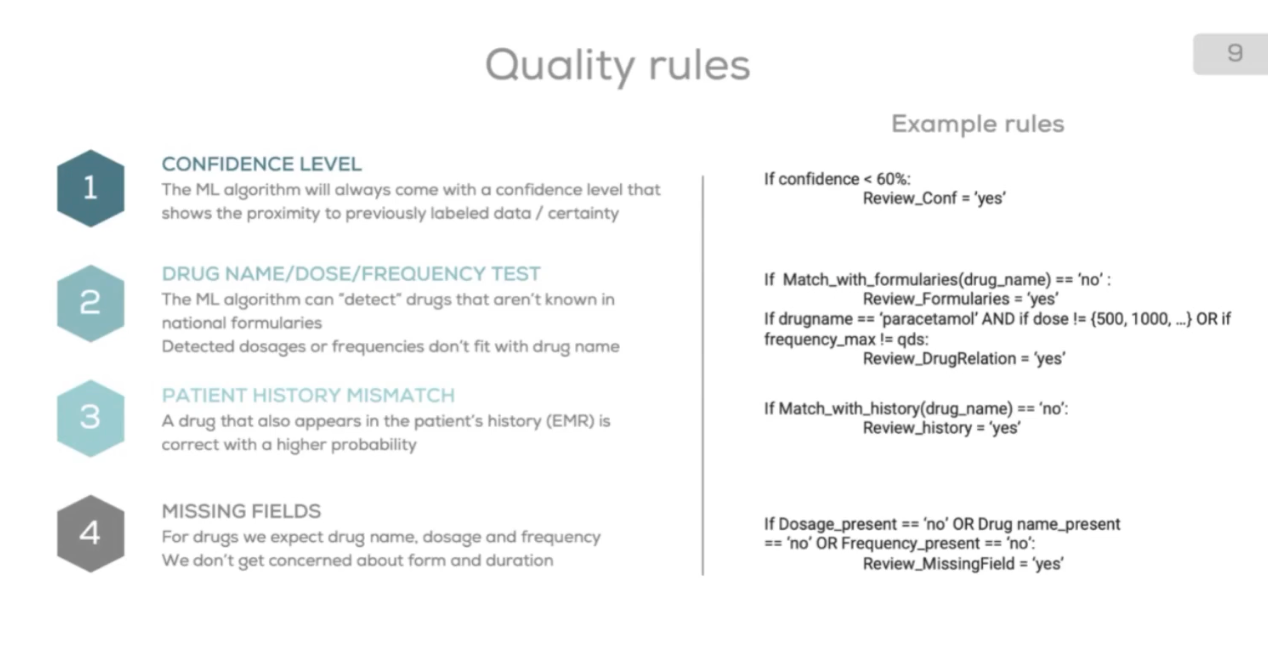
The team designed four targeted quality rules for medication extraction:
- Confidence thresholds to identify low-certainty detections
- Mismatch detection for nonexistent drug names or implausible dosages
- Cross-validation with patient history to surface newly introduced medications
- Missing field detection for absent drug name, dosage, or frequency
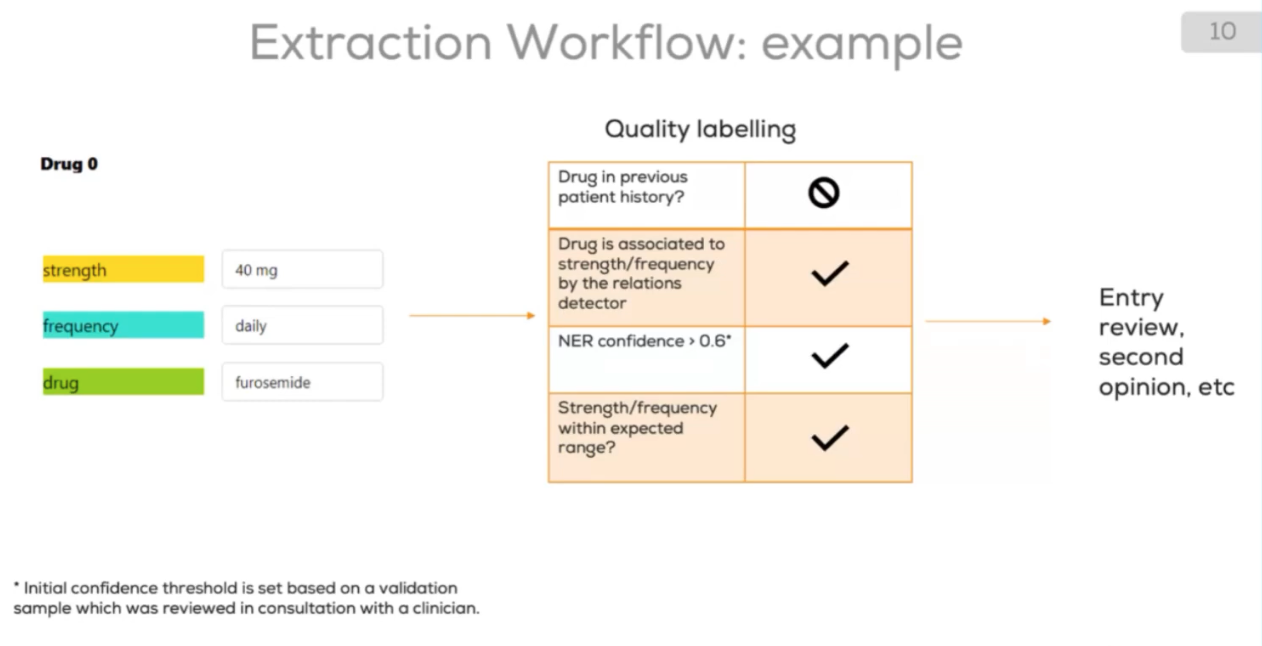
Each extracted item received an automatically assigned quality label indicating whether clinician review was required.
- Clinician-Centered Review Workflow
A dual-path system balanced efficiency and safety:
- Targeted review for items violating quality rules
- Randomized control review on documents that passed all checks, ensuring detection of false negatives
A built-in change log recorded each clinician modification, supporting ongoing optimization of thresholds and rules.
The Impact
The system was evaluated on 144 hospital discharge letters and successfully detected more than 1,300 medications. Key insights included:
- 23% of medications were newly introduced relative to patient history and appropriately flagged for verification.
- 44% lacked dose or frequency due to how real-world text is written, underscoring the value of document-aware rules rather than relying on NLP alone.
- Clinician review found that only 9% of medications required correction and 5% needed dose adjustments, demonstrating both high baseline accuracy and the effectiveness of the quality-assurance workflow.
The Outcome
Through this NLP-enabled quality-assurance framework, the managed-care provider now benefits from a scalable, clinician-aligned system for extracting high-value data from unstructured medical documents.
The solution blends clinical expertise with technical innovation, reducing workload, improving accuracy, and enabling more informed, safer patient-level decisions.
Turning Data Into Opportunity
Spryfox partners with global organizations across data-rich industries to build AI-driven solutions that unlock hidden value. This collaboration demonstrates how a thoughtful approach to data quality, workflow design, and clinician involvement can transform unstructured clinical data into actionable insights.
If your organization is exploring AI readiness, predictive modeling, or AI-powered products, Spryfox can help assess opportunities and develop impactful, reliable solutions.
Contact us for an obligation-free assessment of how AI can deliver value from your data.